Where to Put Ventilation Ducting? How Flat Ventilation Systems Save Centimeters in Low Drop Ceilings
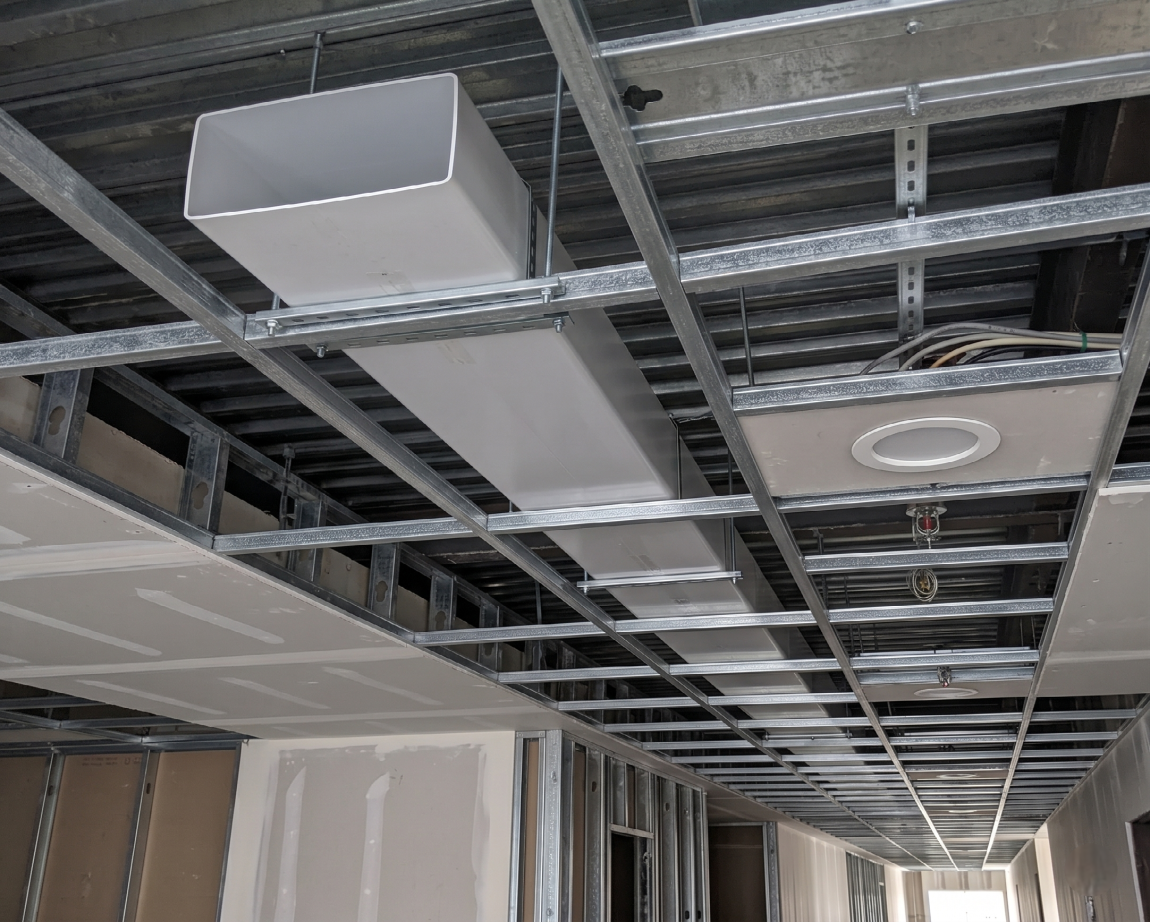
Are you building or renovating a house or apartment on your own? Then you surely know the struggle: fighting for every square centimeter and often for ceiling height as well. When it comes to installing ventilation, range hoods, or bathroom extraction, you hit a classic problem. Where do you hide massive round ducting without turning your plasterboard ceiling into a low tunnel?
We have an elegant and highly practical solution for you that will save precious room height.
The Space Problem: When Round Ducting Lowers the Ceiling
Classic round air ducts are effective, but in interiors with low ceilings—typically hallways, bathrooms, or kitchens—they are a logistical nightmare. If you need to run ducting with a diameter of 100, 125, or 150 mm, you have to lower the entire ceiling by the same height (plus the thickness of the profiles and plasterboard). The result is a cramped space where taller people might feel uncomfortable.
Smart Solution: Flat Plastic Channels
The solution you can hide even in minimal space above the plasterboard is a flat ventilation system. Instead of taking up vertical space, the ductwork expands horizontally.
We have all the necessary sizes for flexible planning in stock. On our HACO e-shop, you will find these options:
110x55 mm System: Ideal for hiding in the thinnest drop ceilings. For air systems up to approx. 300 m³/h.
220x55 mm System: A great middle ground that preserves minimum height while offering higher airflow. For air systems approx. 300 - 600 m³/h.
220x90 mm System: A more robust flat solution for demanding applications, such as high-performance kitchen range hoods. For air systems above approx. 600 m³/h.
DIY Tip: A flat channel with a height of just 55 mm easily fits into a standard plasterboard grid without the need to drastically lower the drop ceiling.
Zero Performance Compromises: How to Correctly Replace Round Ducting with Flat
A common concern when switching from round to flat ducting is loss of performance, restricted airflow, and increased noise levels. However, if you choose the correct equivalent based on cross-sectional area, the ventilation will work just as efficiently.
When planning your DIY project, stick to this precise layout:
For a fan with a 100 mm outlet diameter, the 110x55 mm flat size is appropriate.
For a fan or duct with a 125 mm diameter, the 220x55 mm flat size is appropriate.
For high-capacity extraction (e.g., range hoods) with a 150 mm diameter, the 220x90 mm size is the suitable match.
Thanks to the smooth inner surface of HACO plastic channels, air friction is minimal, ensuring quiet operation and stable airflow without putting extra strain on the fan motor.
Simple Assembly: Installation Without Complex Tools
One of the greatest advantages of HACO plastic ventilation systems is their modularity. The entire system works like a building kit that any DIY enthusiast can assemble.
You don't need any special or expensive tools for installation. All components fit together perfectly:
Flat channels are easily cut to the required length using a simple hacksaw.
Using aerodynamic fittings, connectors, and elbows (both horizontal and vertical), you can easily bypass any obstacle or beam.
If necessary, you can connect the flat system to a round one using transition pieces.
Check out our complete range of plastic ventilation systems on our website. We have all sizes in stock so you can save centimeters in your home smartly, quickly, and without unnecessary compromises!